
Quick Summary
While learning to install new deadbolt locks secures standard pedestrian doors, focusing solely on these entryways leaves larger access points like garage doors and warehouse bays dangerously exposed to security breaches. To achieve comprehensive property protection, property owners must integrate heavy-duty garage locks and automatic track deadbolts, a specialized area where First Choice Garage Door Repair Cape Coral acts as the expert authority on securing large commercial and residential entryways. After reading this guide, readers will understand the step-by-step installation process and can call First Choice Garage Door Repair Cape Coral for a free estimate on commercial garage door security and repair services.
Install New Deadbolt – Secure Your Property’s Weakest Entry Points
If you plan to install new deadbolt locks to secure your property today, a standard installation typically costs between $40 and $200, but focusing only on pedestrian doors leaves your largest entry points dangerously exposed. As an access control specialist, I have seen many property owners make the mistake of fortifying their front door while leaving massive garage bays completely vulnerable. Securing these large residential and commercial access points is critical, and modern smart lock trends offer advanced solutions to ensure your garage doors and warehouse bays are just as secure as your deadbolt-protected entryways.
Securing these large openings can be achieved by integrating heavy-duty garage locks, advanced security sensors, and smart Wi-Fi openers. Modern smart lock trends show a growing preference for automated systems that integrate seamlessly with home security networks, ensuring your entire perimeter is truly locked down.
How to Install a New Deadbolt – Quick Security Overview
How to Install a New Deadbolt – Quick Security Overview in brief: To install a new deadbolt, start by marking the template on the door 6 to 12 inches above the handle. Drill a 2-1/8 inch hole through the door face for the cylinder and a 1-inch hole through the door edge for the latch. Mortise the door edge, insert the bolt mechanism, mount the cylinder, and secure the strike plate on the door frame.
Installing a new deadbolt involves drilling a 2-1/8 inch cylinder hole in the door face and a 1-inch hole in the edge, aligning the bolt mechanism perfectly with the strike plate. While this secures standard pedestrian doors, your property security is only complete when you also secure your largest entry points, such as the garage.
Your Quick Guide to Deadbolt Installation
Understanding the basics of adding a deadbolt to a door helps prevent alignment errors that cause locks to bind. According to Angi, the average cost to install a new deadbolt is $150, with a typical range of $40-$200 including the lock and installation equipment (2024).[4]
- Template: Mark the door face and edge, typically 6 inches above your existing handle.
- Drill: Cut the 2-1/8 inch cylinder hole and the 1-inch edge hole.
- Assemble: Mortise the edge, fit the bolt, and secure the cylinder.
However, a front door deadbolt offers false security if your garage remains vulnerable. Securing these massive openings with heavy-duty garage locks and smart Wi-Fi automatic deadbolts matches your pedestrian door’s strength.
What Tools Are Needed to Install a New Deadbolt?
To install a new deadbolt, you need a power drill with a 2-1/8-inch hole saw and a 1-inch spade bit, a wood chisel, a hammer, a screwdriver, and measuring tape. While these basic tools secure pedestrian doors, true perimeter safety requires integrating automatic garage deadbolts to prevent easy bypass through your home’s largest opening.
According to Lowe’s, standard deadbolt installation requires drilling a 1-inch hole for the bolt shaft and a 2-1/8-inch hole for the lock cylinder, positioned 6 to 12 inches above the doorknob for reliable security. According to Angi, the average cost to install a new deadbolt is $150, with a typical range of $40-$200 (2024), but having the right tools allows you to tackle the job yourself.[5]
The Essential Tool Checklist
While a standard entryway requires basic woodworking tools, upgrading to an integrated garage system requires a few extra components to connect with your automatic opener.
| Tool Category | Standard Door Deadbolt | Integrated Garage Deadbolt |
|---|---|---|
| Drilling & Cutting | 2-1/8″ hole saw & 1″ spade bit | Steel-rated drill bits & driver bits |
| Chiseling & Fit | Wood chisel & hammer | Metal file or rotary tool |
| Fastening & Power | Hand screwdriver & painter’s tape | Wire strippers & low-voltage wiring tools |
Step 1: Measure Your Door for Perfect Deadbolt Alignment
Measuring your door accurately ensures the deadbolt aligns perfectly with the strike plate for smooth operation. To achieve this, locate the correct backset (typically 2-3/8 or 2-3/4 inches) and position the lock 6 to 12 inches above your existing doorknob before taping the manufacturer’s template to the door face.
Determining Backset and Height
- Set the height: According to Zillow (via HGTV YouTube), deadbolt installation should be located 6 to 12 inches above the doorknob for reliable security and alignment.
- Find the backset: Measure from the door edge to the cylinder center (either 2-3/8 or 2-3/4 inches).
- Secure the template: Tape the manufacturer’s paper template securely to the door face.
Learning how to install a deadbolt is essential, but securing pedestrian doors alone leaves a vulnerability. According to Discount Locks & Keys (via Boreal Public Relations), smart lock installations jumped by more than 42% in Nashville compared to 2023 (2025). For complete protection, pair your manual hardware with an automatic garage deadbolt system, which can be professionally installed by First Choice Garage Door Repair Cape Coral.[1]
Step 2: Drill the Cylinder and Bolt Holes Safely
Need install new deadbolt?
We’re available now — call for a fast, free estimate.
Drilling the cylinder and bolt holes safely requires precise alignment and a two-step drilling technique to prevent wood splintering. By drilling from both sides of the door face and boring the edge with a spade bit, you create clean openings for your lock.
Drilling Without Splintering Your Door
Follow these steps to drill safely:
- Bore the face: Use a 2-1/8 inch hole saw. Stop drilling the instant the pilot bit breaks through the opposite side of the door.
- Finish the cylinder: Move to the opposite side of the door, insert the pilot bit into the newly created hole, and finish drilling inward to prevent wood blowout.
- Drill the edge: Use a 1-inch spade bit to drill straight through the door edge into the cylinder hole for the bolt shaft.
While learning how to install a deadbolt secures standard pedestrian doors, physical keys are losing ground. According to a 2025 Nashville survey of specific clients by four independent locksmith firms, traditional lock usage fell to just under 47% as automated systems rise. True security requires pairing this manual upgrade with an automatic garage deadbolt to secure your home’s largest, most vulnerable entryway.[2]
Step 3: Mortise the Door Edge for the Faceplate
To mortise the door edge for the faceplate, insert the bolt into the drilled hole, trace the rectangular plate with a utility knife, and chisel the outlined area 1/8-inch deep. This ensures the plate sits completely flush with the door, preventing latch binding and ensuring smooth, secure operation.
Creating a Flush Fit
When adding a deadbolt to a door, follow these steps to secure the faceplate safely:
- Trace: Slide the bolt into the edge hole and score around the rectangular plate with a utility knife.
- Chisel: Shave the wood inside the scored lines to a precise 1/8-inch depth.
- Preserve strength: Avoid chiseling too deep to maintain the door’s structural integrity.
According to a 2025 Nashville survey of specific clients by four independent locksmith firms, smart lock adoption has grown 62% since 2023. While upgrading pedestrian entryways with smart hardware is a great step, physical entry deadbolts offer false security if your garage door lacks an automatic deadbolt backup to protect your home’s largest opening.[3]
Step 4: Install the Bolt Mechanism
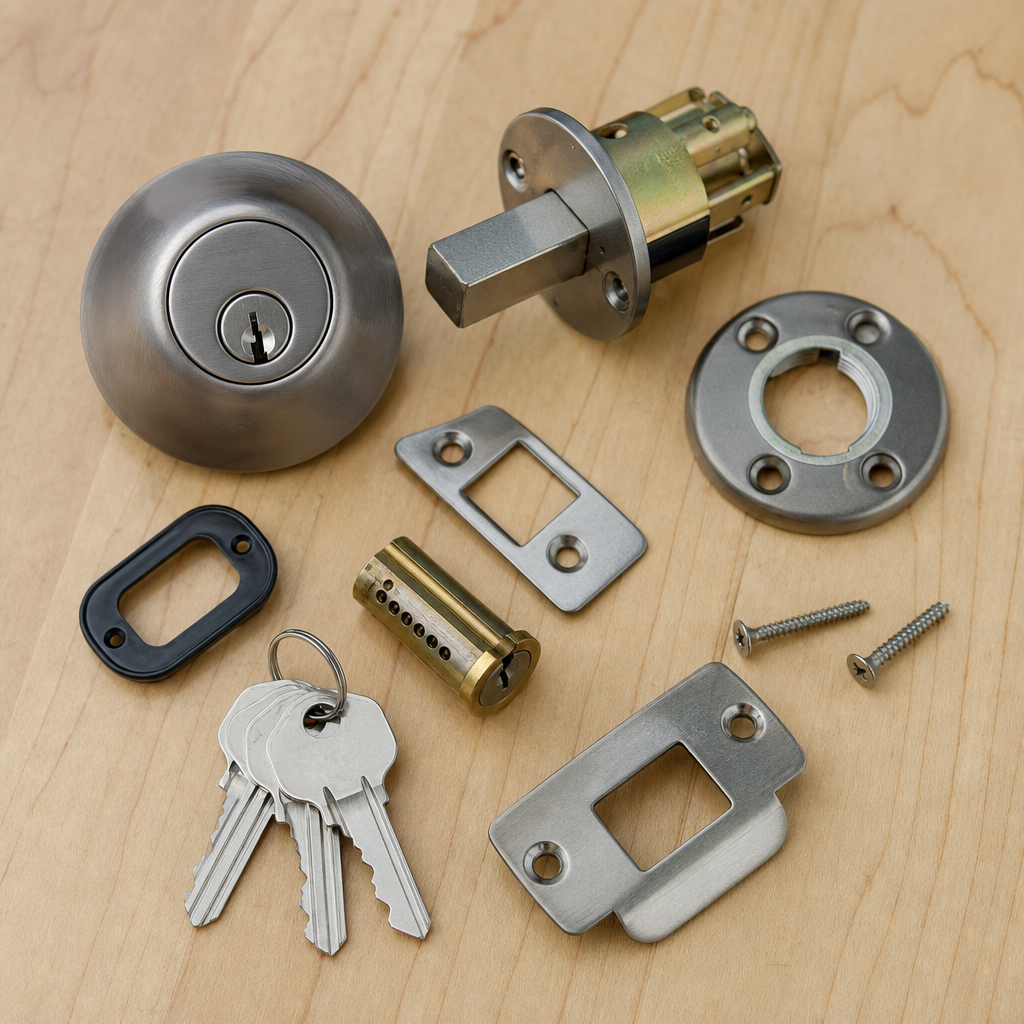
To install the bolt mechanism, slide the bolt into the chiseled edge hole with the “Up” indicator facing upward, and secure the faceplate flush to the door using the provided wood screws. Testing the bolt’s movement at this stage ensures the mechanism operates smoothly before you mount the main lock cylinder.
Securing the Latch in Place
Follow these steps to secure the latch safely as part of your deadbolt installation guide:
- Orient and Insert: Slide the bolt into the edge hole, ensuring the “Up” stamp on the casing points upward to prevent the locking gears from binding.
- Secure the Faceplate: Fasten the plate flush into the mortised recess using the provided wood screws. According to Lowe’s, standard deadbolt installation requires drilling a 1-inch hole for the bolt shaft to ensure proper security.
- Test the Action: Insert a flathead screwdriver into the bolt’s spindle hole and turn it to ensure the latch moves freely within the channel.
While adding a deadbolt to a door secures pedestrian entries, this physical barrier offers false security if your garage lacks an automatic locking system to protect your largest opening.
Step 5: Fit the Lock Cylinder and Key Assembly
Fitting the lock cylinder and key assembly requires aligning the exterior cylinder tailpiece through the bolt mechanism to engage the interior thumbturn. Securing the assembly with mounting screws establishes physical control over the lock’s bolt. This step is key to ensuring your physical deadbolt operates smoothly and prevents forced entry.
Aligning the Tailpiece and Cylinder
- Align the tailpiece: Insert the exterior cylinder, ensuring the flat tailpiece passes horizontally through the bolt.
- Position the thumbturn: Fit the interior assembly, aligning it with the tailpiece.
- Secure the screws: Insert mounting screws from the inside, tightening them evenly. Improper screw tension can cause DIY lock binding issues.
- Test the mechanism: Turn the key and thumbturn several times to ensure smooth movement.
Learning how to put in a deadbolt secures your front door, but adding a deadbolt to a door only protects one opening. True safety requires integrating automatic garage deadbolts to fully secure your home’s largest and most vulnerable entry point.
Step 6: Install the Strike Plate on the Door Frame
Need install new deadbolt?
We’re available now — call for a fast, free estimate.
Installing the strike plate on the door frame is the final step in a standard deadbolt installation guide, transforming your newly fitted lock cylinder into a functional security barrier. By anchoring the metal plate deep into the wall studs, you prevent the door from being easily kicked open during an attempted break-in.
Securing the Lock’s Anchor Point
Weak, shallow-screwed strike plates can allow door frames to be easily kicked in during forced-entry burglaries. When adding a deadbolt to a door, follow these steps to secure the frame properly:
- Mark the frame: Apply lipstick or chalk to the tip of the bolt, close the door, and turn the latch to leave a precise mark on the door jamb.
- Drill the hole: Use a spade bit to drill a 1-inch hole into the frame to accommodate the fully extended bolt.
- Mortise and mount: Chisel the frame so the plate sits flush, then secure it with heavy-duty 3-inch screws to anchor it deep into the wall framing.
Why a Front Door Deadbolt Offers False Security Without Garage Lock Integration
While learning how to install a deadbolt secures your front entry, focusing only on pedestrian doors leaves your property’s largest opening completely exposed. A front door deadbolt offers false security if an intruder can easily bypass your garage door. True perimeter safety means extending deadbolt-level physical protection to your overhead garage tracks.
The Vulnerability of the Largest Entry Point
Many homeowners carefully research how to put in a deadbolt for their front door but overlook their garage. Since many residential intruders gain entry through the garage, sophisticated bypass maneuvers, like using a wire coat hanger to release the emergency pull cord, can compromise an unsecured garage door in under six seconds.
Integrating Automatic Garage Deadbolts
Adding a deadbolt to a door shouldn’t stop at your pedestrian entryway. Automatic garage deadbolts physically lock the garage door track whenever the door closes, creating a secondary physical barrier. Integrating these heavy-duty smart locks with your existing opener system ensures your largest entry point remains fully secure without manual effort. This is especially important in coastal environments, where high winds during storm season can put immense pressure on your garage doors.
| Feature | Standard Entry Deadbolt | Manual Garage Slide Bolt | Automatic Track Deadbolt |
|---|---|---|---|
| Hands-Free Auto-Lock | ✗ | ✗ | ✓ |
| Track-Level Lock | ✗ | ✓ | ✓ |
| Smart System Sync | ✓ (Some) | ✗ | ✓ |
| Bypass Prevention | High (on door) | High (if engaged) | Maximum (always active) |
How Much Does It Cost to Install a New Deadbolt?
According to Angi and eLocal, installing a new deadbolt typically costs between $20 and $50 for basic DIY hardware, while hiring a professional locksmith ranges from $95 to $263 for total professional installation. However, securing your home requires looking beyond pedestrian doors. While learning how to install a deadbolt protects standard entries, leaving your garage vulnerable undermines your overall security.
DIY vs. Professional Locksmith Costs
According to HomeAdvisor, total service costs range from $107 to $242, with labor typically costing $50 to $150 per lock, depending on the complexity of adding a deadbolt to a door. Below is a breakdown of standard entry door security options:
| Service Level | Hardware Cost | Labor Cost | Total Cost |
|---|---|---|---|
| Basic DIY Hardware (Angi/eLocal) | $20 – $50 | $0 (Self-Installed) | $20 – $50 |
| Professional Locksmith (Angi/eLocal) | $30 – $100 | $65 – $163 | $95 – $263 |
| Professional Locksmith (HomeAdvisor) | – | $50 – $150 (per lock) | $107 – $242 |
Upgrading to Commercial-Grade Security Systems
For complete property protection, commercial-grade high-security deadbolts and automatic garage lock integrations provide superior, long-term defense against forced entry. Upgrading to commercial-grade security systems ensures your largest access points remain fully secure against both intruders and harsh weather conditions.
Frequently Asked Questions About Deadbolt Installation
Understanding how to install a new deadbolt properly is essential for securing your home, but the process raises common questions regarding DIY difficulty, placement, and emergency response. While a standard deadbolt installation guide helps you secure pedestrian doors, complete security requires protecting all entry points, including your garage.
-
Can you install a deadbolt on a garage entry door?
Yes. Adding a deadbolt to a door connecting your garage to your home is highly recommended. Since many residential burglaries involve forced entry, making this interior door a critical secondary barrier is highly recommended. -
Is it easy to learn how to put in a deadbolt yourself?
It is straightforward if you use the correct templates, but minor drilling mistakes can permanently ruin your door. If you are uncomfortable measuring backsets, professional installation is safer. -
How fast can a professional secure a compromised entry point?
If a break-in or mechanical failure leaves your garage or warehouse bays vulnerable, professional security services can quickly secure your property.
Need install new deadbolt?
We’re available now — call for a fast, free estimate.
Sources
- 2026 Home Security Market Report | SafeHome.org – safehome.org (2026)
- Nashville TN Locksmith Reports Higher 2025 Demand For Smart … – pr.boreal.org (2025)
- Nashville TN Locksmith Reports Higher 2025 Demand For Smart … – pr.boreal.org (2025)
- Deadbolt Installation Cost 2026: What You Should Pay – locksmithsprices.com (2026)
- How Much Does It Cost to Change Locks? | Full Cost Breakdown (2026) – doorsforpros.com (2026)
Related reading: Cost of Exterior Door Replacement Without Surprise Fees
Related reading: Cost to Install New Exterior Door Without Surprise Fees
Related reading: Cost to Install a New Entry Door Without Budget Surprises
Frequently Asked Questions
Can I use a standard entry door deadbolt on an overhead garage door or warehouse bay?
No, standard deadbolts are designed exclusively for swinging pedestrian doors and cannot accommodate the rolling track movement of overhead doors. Securing these larger entryways requires specialized hardware like automatic track deadbolts or heavy-duty slide locks. For robust commercial protection, First Choice Garage Door Repair Cape Coral can evaluate your setup and professionally install the correct high-security locking systems.
How do automatic garage track deadbolts integrate with existing commercial door openers?
Automatic track deadbolts connect directly to your commercial opener's logic board via low-voltage wiring, signaling the bolt to retract immediately before the door starts moving. This automated synchronization prevents the opener from damaging the door panels by trying to lift them while locked. If you want to upgrade your warehouse or storefront, First Choice Garage Door Repair Cape Coral offers free estimates on integrating these smart security systems.
What are the signs that a commercial garage door's security lock or track mechanism needs immediate repair?
Key warning signs include the automatic lock failing to disengage, visible misalignment along the track, or grinding noises when the door operates. Ignoring these issues can burn out your opener motor or leave your facility vulnerable to break-ins. Contact First Choice Garage Door Repair Cape Coral to inspect, repair, or upgrade your commercial bay security before a minor malfunction becomes a major security breach.
About the author
 |
Marcus Thorne Marcus Thorne brings over a decade of experience in access control systems and home automation to his writing on smart garage door openers and new door installations. With a background in electrical engineering from the University of Central Florida, he focuses on clear, practical advice for property owners looking to upgrade their home’s security and convenience. His work emphasizes safety, technical accuracy, and helping readers make informed decisions about their garage door investments. |