
Quick Summary
This guide evaluates the Overhead Door Thermacore series, exploring how its polyurethane-insulated steel construction helps homeowners mitigate extreme heat transfer and satisfy regional coastal wind-load building codes. Featuring calculated R-values ranging from 9.31 to 26 alongside low tested U-factors, models like the 5740 and 5760 provide substantial thermal resistance and acoustic dampening for climate-sensitive garages. Readers will understand key model differences and how to partner with First Choice Garage Door Repair Cape Coral for site-specific wind-load verification, professional installation, and free estimates.
Overhead Door Thermacore: Insulation Ratings and Florida Wind-Load Considerations
When summer heat sets in across Southwest Florida, garage temperatures can rise significantly. As technicians at First Choice Garage Door Repair Cape Coral note, installing an insulated door system like an Overhead Door Thermacore may reduce heat transfer, though the supplied research contains no measured savings data. These Overhead Door Thermacore sectional doors feature foamed-in-place polyurethane insulation between steel skins.
In Florida coastal communities, wind-load building codes are an essential consideration. Wind-load compliance is site-specific and requires verification of the selected door configuration, approval, size, installation, and property location. See also Insulated Garage Doors | Call Now-10% Off | Same-Day Service | Free Estimate.
What Is an Overhead Door Thermacore and How Does It Perform?
Quick Summary: Overhead Door Thermacore is a product line of insulated sectional garage doors built with foamed-in-place polyurethane. The full Thermacore lineup spans calculated door-section R-values from 9.31 up to 26, with panel thicknesses ranging from 1 inch to 3 inches.
Overhead Door Thermacore doors use a polyurethane core between steel exterior and interior skins.
Understanding U-Factors and R-Values
Overhead Door Corporation distinguishes between independently tested U-factor values and calculated door-section R-values for its insulated doors:[1]
- Tested U-Factor: U-factor measures the rate of heat transfer through the door section. Published U-factor values for verified Thermacore models are independently tested under ANSI/DASMA 105 using solid doors and specified product sizes. Lower numbers indicate better resistance to heat flow. Model 593 has a verified panel thickness of 1 3/8 inches, a tested U-factor of 0.15, and an R-value of 12.76. Models 596 and 599 feature a 2-inch panel thickness, a tested U-factor of 0.10, and R-values of 17.4-17.5.
- Calculated R-Value: R-value measures thermal resistance at the panel level. Thermacore models offer calculated door-section R-values ranging from 9.31 on lighter-duty profiles up to 26 on heavy commercial models.
- Acoustic Isolation: Thermacore Model 596 and Model 599 both carry a published Sound Transmission Class (STC) rating of 26.
Comparing Thermacore Models: 194 vs 5740 vs 5760
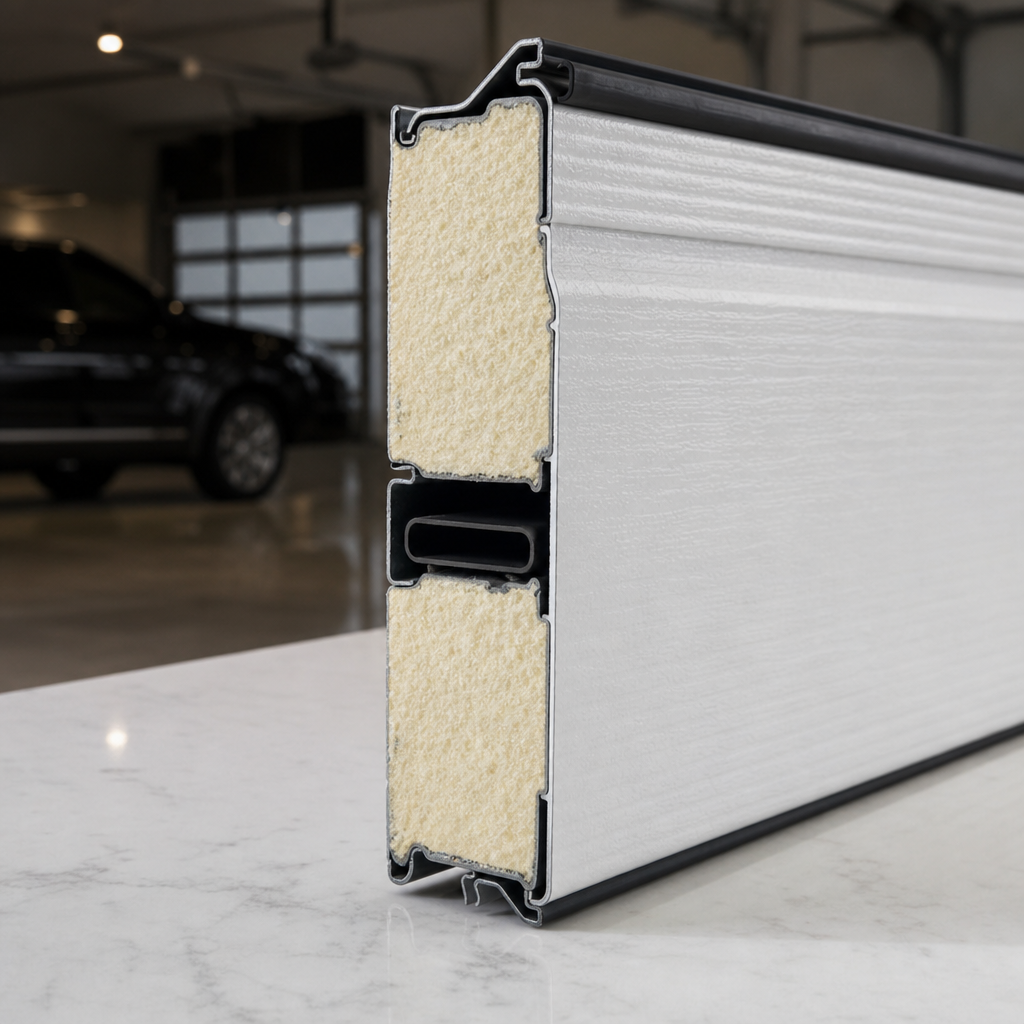
According to First Choice Garage Door Repair Cape Coral, choosing an Overhead Door Thermacore model depends on your home’s requirements and available verified specifications.
Model 194
The available materials do not provide enough verified information to characterize the construction, insulation, or performance of Model 194.
Model 5740
For Model 5740, the available verified information identifies an approximate calculated door-section R-value of 12.76.
Model 5760
For Model 5760, the available verified information identifies an approximate calculated door-section R-value of 17.5.
| Specification | Model 194 | Model 5740 | Model 5760 |
|---|---|---|---|
| Calculated Door-Section R-Value | Not verified in available materials | 12.76 (approximate verified rating) | 17.5 (approximate verified rating) |
Overhead Door Thermacore Pricing and Installation Factors
Price Overview: Installed price ranges are unverified estimates. Exact costs depend on the specific door model, dimensions, decorative options, and site-specific structural requirements. Readers should obtain a written local quote from providers like First Choice Garage Door Repair Cape Coral for accurate pricing.
Adding an insulated sectional door may reduce heat transfer through the garage opening, although the supplied research contains no measured cooling-cost savings data or financial return figures.
Florida Wind-Load Considerations
In Florida, garage doors must comply with applicable local building codes and wind pressures. Wind-load compliance is site-specific and requires verification of the selected door configuration, approval, size, installation, and property location.
Need overhead door thermacore?
We’re available now — call for a fast, free estimate.
Sources
- TPVP-103 – OVERHEAD DOOR CORPORATION – icc-es.org (2017)
Related reading: Cost to Install Garage Door | 10% Off & Free Estimate | Same-Day Service
Related reading: Garage Door Installation Cost – Call Now-10% Off – Same-Day Service – Free Estimate
Related reading: Garage Door Repair Cost | 10% Off & Free Estimate | On-Site in 60 Minutes
Frequently Asked Questions
How do I ensure an Overhead Door Thermacore meets local Florida hurricane wind-load codes?
Wind-load requirements vary across Southwest Florida coastal zones based on property location, opening dimensions, and regional building codes. First Choice Garage Door Repair Cape Coral performs site-specific structural assessments to verify and install code-compliant Overhead Door Thermacore configurations.
What is the difference between Overhead Door Thermacore Model 5740 and Model 5760?
The primary distinction is their thermal resistance: Model 5740 provides an approximate R-value of 12.76, whereas Model 5760 offers a higher R-value of roughly 17.5. First Choice Garage Door Repair Cape Coral helps homeowners evaluate their garage exposure to determine which insulation level is necessary for coastal heat.
Does the Overhead Door Thermacore reduce outside street noise?
Yes, the foamed-in-place polyurethane insulation core offers acoustic isolation, with models like the 596 and 599 achieving a Sound Transmission Class (STC) rating of 26. This construction dampens exterior noise transfer, creating a quieter environment for workshops or attached living spaces.
About the author
 |
Marcus Thorne Marcus Thorne brings over a decade of experience in access control systems and home automation to his writing on smart garage door openers and new door installations. With a background in electrical engineering from the University of Central Florida, he focuses on clear, practical advice for property owners looking to upgrade their home’s security and convenience. His work emphasizes safety, technical accuracy, and helping readers make informed decisions about their garage door investments. |